SHOAL at the IUCN World Conservation Congress

SHOAL’s Grace Brady and Georgie Bull at the SHOAL booth. © SHOAL

SHOAL’s Grace Brady and Georgie Bull at the SHOAL booth. © SHOAL

1000 Fishes gathers support in Abu Dhabi.

The 2025 IUCN World Conservation Congress in Abu Dhabi, 9-15 October, brought together thousands of people working to protect the planet’s biodiversity. For SHOAL, the Congress was an opportunity not only to reconnect with partners and friends from across the world and help shape global conservation policy, but also to gather fresh support for how the 1000 Fishes initiative can help turn back the clock on freshwater extinctions.

This year, SHOAL took part in six sessions across the Congress programme, each addressing critical gaps in freshwater conservation. Three were Forum sessions, which featured in depth discussions, and three were Exhibition sessions, where SHOAL and partners discussed their projects and programmes in various pavilions in the Exhibition Hall.


© Wai Kit
The opening ceremony. © Wai Kit


Forum sessions:

  1. Achieving Conservation and Socio-economic Benefits from Managing Invasive Alien Species (IAS) in Freshwater Ecosystems
  2. Global Mechanisms for the Conservation of Overlooked Species
  3. Overlooked Yet Essential: Advancing the Recognition and Conservation of Springs for Biodiversity and Society

Exhibition sessions:

  1. Innovative Actions for Effective and Resilient Freshwater Connectivity and Conservation
  2. Saving ASAP Fishes: A Radically Collaborative Approach
  3. Transforming Biodiversity Conservation Beyond Protected Areas – OECMs in Asia to Advance KM-GBF Target 3

While each session offered valuable insights, the Forum sessions presented the best opportunity for audience collaboration and rich level of detail. Each of the three provided valuable insights for freshwater biodiversity conservation, and highlighted the growing partnerships and momentum behind SHOAL’s 1000 Fishes initiative.


IUCN WCC opening address © Wai Kit


Achieving Conservation and Socio-economic Benefits from Managing Invasive Alien Species (IAS) in Freshwater Ecosystems

In collaboration with Freshwater Life, International Rivers, the IUCN Species Survival Commission, Office Français de la Biodiversité (OFB), and TARSIUS, SHOAL co-hosted this session, which culminated in a joint statement committing all six organisations to stronger cooperation on invasive species management.

The speakers, including Muhammad Iqram (TARSIUS), Gregg Howald (Freshwater Life), Victoria Lichtshein (IUCN SSC), Joshua Klemm (International Rivers), and Guillaume Gigot (OFB), presented evidence that prevention is the most effective and cost-efficient approach. But they also shared success stories showing that, where invasives have already taken hold, targeted, science-based management can bring ecosystems back to life.

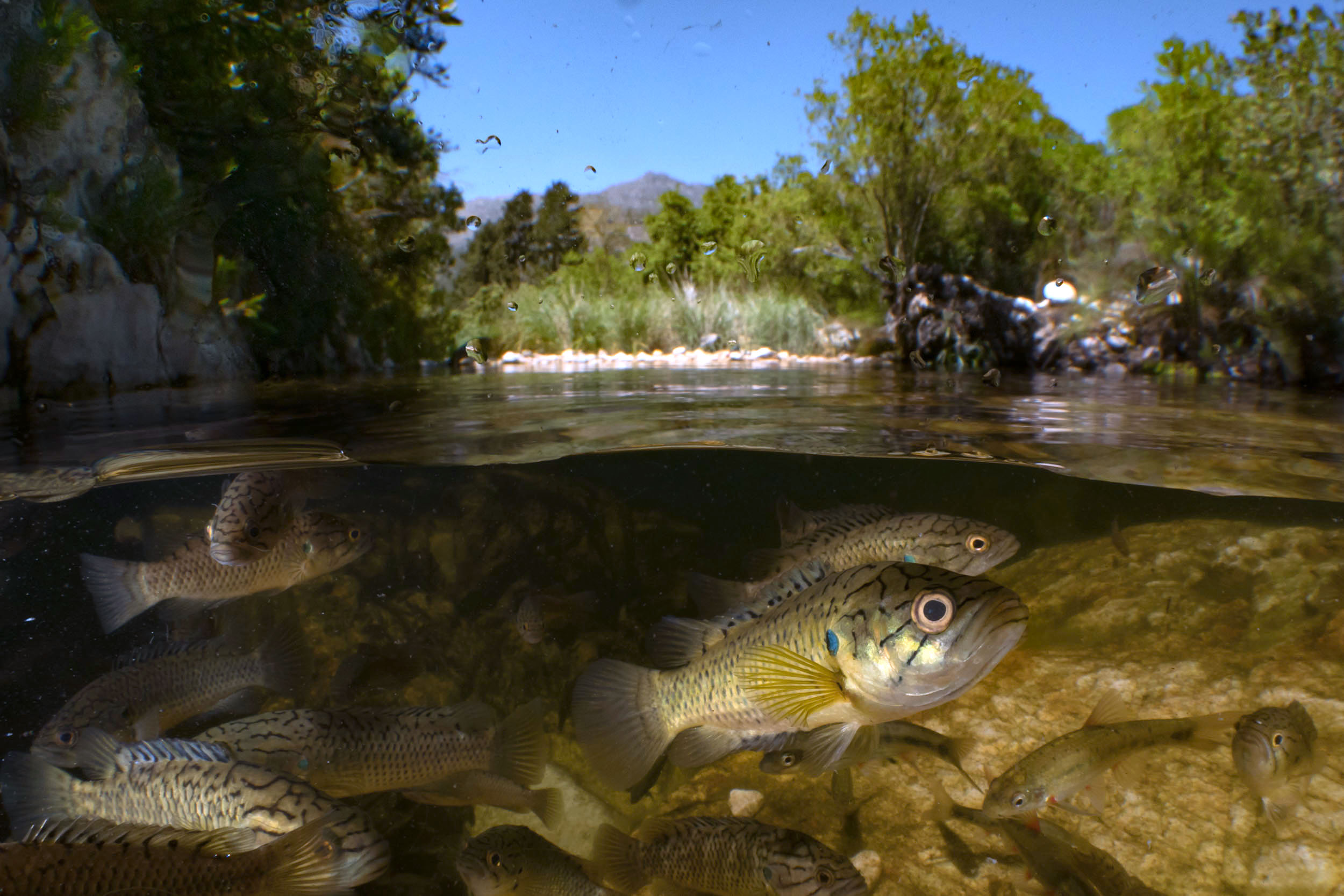
Fundación Somuncura and Freshwater Life’s restoration in Patagonia, which completely removed invasive fish from a section of the Valcheta Stream, causing the dramatic recovery of the Naked Characin (Gymnocharacinus bergii) and Valcheta Stream Frog (Atelognathus rivularis), was highlighted as a leading example.

Graden Froese, CEO of Freshwater Life, said, “Too often, freshwater invasive species can feel like an overwhelming problem. But invasive species can be dealt with, and even permanently removed, from many rivers and lakes. The results, for people and nature, are spectacular. This gathering, the first of its kind at the IUCN’s world conservation congress, reminded and energized us around the importance of action.”

Dileri Berdeja, conservation consultant from Berde Environmental Consulting, who was instrumental in pulling this session together, said, “This session went beyond ecological concerns, emphasising how invasive species intersect with the socio-cultural and economic dimensions of local communities. Managing these species is essential not only for protecting biodiversity but also for safeguarding the livelihoods that depend on healthy freshwater systems. Witnessing collaboration among leading organisations and experts was both inspiring and a much-needed step toward stronger, coordinated global action.”


Global Mechanisms for the Conservation of Overlooked Species

Hosted by Synchronicity Earth and partners including Amphibian Survival Alliance, IUCN Asian Species Action Partnership (ASAP), Mandai Nature, and SHOAL, this session explored how new global frameworks can raise the profile of species often left behind by mainstream conservation, from freshwater fishes to invertebrates and plants. It set the tone for a broader movement recognising that small, data-deficient, and non-charismatic species are every bit as vital to ecosystems as their larger counterparts.

SHOAL highlighted how the 1,000 Fishes Blueprint and its network of Priority Fishes already provide a practical model for identifying and investing in overlooked freshwater species. Participants agreed that better funding mechanisms, stronger coordination, and policy recognition are essential to scaling up this work.

Mike Baltzer, Executive Director of SHOAL, said, “This session fizzed with energy and actionable discussion for how we can together make a huge difference to overlooked freshwater biodiversity. We heard about many new mechanisms and solutions underpinned by a determination for change. This included many visionary funders and host organisations happy to take on the challenge to mobilise action to save these neglected species. Next step is to engage more funders and organisations”.


Overlooked Yet Essential: Advancing the Recognition and Conservation of Springs for Biodiversity and Society

Left to right: Topiltzin Contreras-Macbeath, Joseph Holway, Chouly Ou, Catherine Sayer, john Simaika

Springs, the literal sources of many rivers, received rare attention in this session, which SHOAL co-organised with Re:wild, the International Water Management Institute, the Springs Stewardship Institute, Saint Louis Zoo, and the IUCN Species Survival Commission. It called for global recognition of springs as unique freshwater ecosystems, vital both to biodiversity and to the human communities that depend on them.

The discussion built momentum behind Motion 016 Springs under threat: Mobilising urgent action for neglected freshwater ecosystems, one of two SHOAL-proposed motions at the Congress, both of which were approved and elevated to IUCN Resolutions.

Joseph Holway, Assistant Director at the Springs Stewardship Institute (SSI), said, “At SSI, we have been actively studying and protecting springs for the past four decades, yet their significance has too often fallen on deaf ears. That is why it fills me with hope to see a room full of scientists and conservationists dedicating their time and energy to these systems, these tiny focal points in the landscape that collectively weave together the fabric of biodiversity itself. Without springs, we would have only a fraction of the perennial rivers, wetlands, and ecosystems that sustain life across the planet. It is time that springs receive the attention they deserve as the lifeblood upon which both freshwater and terrestrial biodiversity depend.”

Chouly Ou, Freshwater Fish Conservation Coordinator of SHOAL/Re:wild, addded, “This session provided a much-needed platform for spring experts to meet in person, exchange knowledge, and identify concrete steps to move from motion to action. We discussed the roadmap for protecting springs, the establishment of the IUCN Springs Task Force, and the creation of a Global Springs Alliance. These are essential steps following the adoption of the motion as an official IUCN resolution, and this session marked an important milestone in turning the resolution into coordinated global action”.


Exhibition sessions

Throughout the Exibition sessions, SHOAL and partners highlighted many of the challenges and successes they have been involved in through their work to protect freshwater biodiversity, such as the efficacy of using Other Effective Conservation Measures (OECMS) to solve many freshwater conservation needs, and case studies highlighting how being innovative can help safeguard river connectivity and protect habitats that are highly important for local communities.

Jessica Judith Grefa Huatatoca, a biologist and Indigenous Kichwa woman from Santa Clara, Ecuador, who works with Piatua Resiste to protect the Piatua River and the cultural heritage of the Kichwa people, and who was a panellist in the Innovative Actions for Effective and Resilient Freshwater Connectivity and Conservation session offered some profound words about connectivity: “In the Kichwa tradition, humans are aquatic beings; we don’t say we learn to walk, but that we learn to swim. We are one interconnected, flowing system”.


© Wai Kit
Left to right: Michael Edmondstone, Nerissa Chao, Nathaniel Ng, Shera, and Alex McWilliam discuss ASAP fishes in the IUCN Asia Pavilion. © Wai Kit


Motions and Policy Wins

SHOAL closely followed 15 motions relevant to freshwater conservation. Each was approved, meaning these issues now become formal IUCN policy. Three were debated and adopted in the Members’ Assembly:

  • Motion 067: Living in harmony with rivers through the rights of nature and ecocentric law
  • Motion 094: Recognising the importance of Indigenous languages, knowledge and cultural heritage in biodiversity conservation
  • Motion 108: Development of IUCN guidelines to effectively control the commercial pet trade in terrestrial wildlife

Each adopted Resolution, guides IUCN’s future actions and influences global policy, funding, and awareness.

Motions

Growing the SHOAL

Beyond the sessions, SHOAL’s exhibition booth drew crowds with an interactive fishing game, where visitors could win Priority Fishes posters and learn about the species and people behind them. It proved a fantastic way to spark conversations about freshwater life and the global network working to protect it.

The Congress also marked the first time the entire six-member SHOAL team gathered in person. For a team that works across continents, this made the week especially memorable.

In Abu Dhabi, freshwater voices were loud, united, and full of momentum, showing how much hunger and ambition there is among the wider SHOAL partnership to ensure the 1000 Fishes initiative will succeed. SHOAL leaves the Congress energised and inspired to build on the productive conversations that were had and connections that were made.


SHOAL booth © SHOAL
Georgie Bull’s poster of painted SHOAL Priority Fishes received many justified compliments at the booth. © SHOAL

‘The planet will never see this species again’ – the fight to save Krabi’s endemic Betta

© IUCN Asia
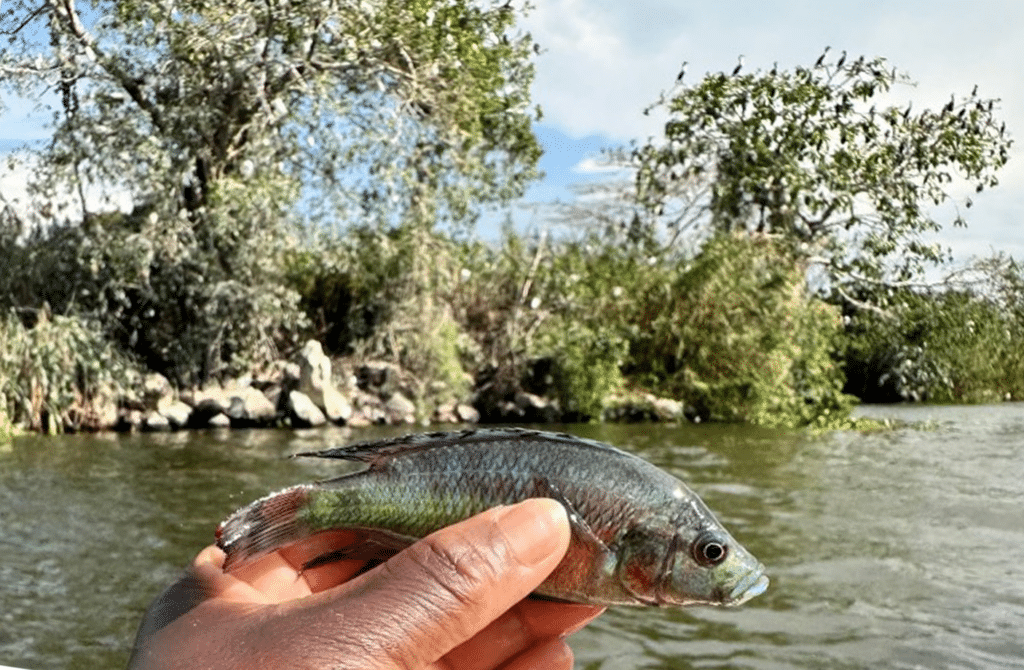
A Krabi Mouth-Brooding Betta collected then released for population surveys conducted by BCST. © IUCN Asia

16 years ago, Mr Manaswut Chusaeng posted a picture of a fish he didn’t recognise on Panthip – a popular discussion forum in Thailand – requesting someone to help him identify the species. Despite the lack of response and not being able to find the fish again when he returned to the same spot, he took on a career as a tour guide in hopes of discovering the species through his work.

Today, the tiny fish – distinguished by its rounded fin, sometimes blueish gill, and males that incubate eggs in their mouth – is formally recognised as the Krabi Mouth-Brooding Betta. Listed as Critically Endangered on the IUCN Red List of Threatened Species™, this species can only be found in the crystal clear limestone karst streams and emerald pools of Krabi province, Thailand.

Among the risks that threaten their future is the conversion of their habitat to residential and agriculture areas, which can also be a source of pollution that affect the streams and pools where they occur. As tourism continues to ramp up in Thailand’s popular southern province, the natural landscape is being altered to increase accessibility for visitors. The Betta has also grown in popularity in the international trade market. “We see tourists collect them quite often, apparently one of these fish can sell for a lot of money,” said a community warden at one of emerald pools frequented by tourists.

emerald pool © IUCN Asia
The Krabi Mouth Brooding Betta can only be found in the crystal clear limestone karst streams and emerald pools of Krabi province, Thailand. © IUCN Asia

In an effort to protect the Betta, the Bird Conservation Society of Thailand (BCST) – one of the oldest organisations conserving birds and nature in Thailand – are collaborating with national and local experts to conduct surveys to understand the population, distribution and the threats to the species. This is being implemented through the Engaging Communities To Safeguard the Simple Mouth Brooder (Betta simplex) In Krabi, Thailand project, supported by IUCN and the Critical Ecosystem Partnership Fund (CEPF) with technical support from SHOAL.

When BCST began looking for experts to form a local conservation committee for the Betta, Mr Chusaeng emerged as one of the leading figures. Having spent over a decade learning about them, he confidently leads the survey team to areas where the tiny Betta can be found within 10 minutes.

BCST’s survey team record data on the water quality where the species is commonly found © IUCN Asia

Findings from BCST’s data will be consolidated into a report, providing the first comprehensive account of the species. The report will include a series of recommendations to inform conservation plans. This includes defining protection areas, particularly where eggs are laid, as well as buffer and monitoring zones, to observe and learn more about their behaviour and population.

“I encourage collaboration between the local authority and community, especially to help understand how we can minimise our impact on the fish population,” said Mr Chusaeng. The report will include a community-based conservation strategy that helps all actors, from community members to the local government, understand their role in protecting Krabi’s endemic fish.

Mr Chusaeng has noticed a considerable difference in the attitude of locals in the last five years. As they learn more about the species, there’s growing interest to protect them. BCST are building on this momentum by running awareness raising campaigns to help the local community understand the ecological significance of the fish. With support from the local authority, they hope that the Krabi Mouth-Brooding Betta can be established as an icon and flagship for biodiversity conservation efforts in the province.

© IUCN Asia
Mr Chusaeng at the “Future of Krabi Mouth-Brooding Betta and Survival of Habitats Outside Conservation Areas” event organised by BCST © Bird Conservation Society Thailand (BCST)

Krabi’s endemic Betta is one of many species that make the Indo-Burma region such a vibrant biodiversity hotspot. IUCN will continue to support organisations that work alongside communities to empower them with the tools and understanding to protect these unique species.

Mr Chusaeng also continues his plight to raise awareness and protect Krabi’s local treasure. “If they disappear from this area, then the planet will never see this species again,” he said. “It’s up to us to ensure this doesn’t happen.”

© IUCN Asia
Mr Chusaeng leads a survey team studying the Mouth-Brooding Betta’s habitat.  © IUCN Asia

About CEPF

CEPF is a joint initiative of l’Agence Française de Développement, Conservation International, the European Union, Fondation Hans Wilsdorf, the Global Environment Facility, the Government of Canada, the Government of Japan and the World Bank. A fundamental goal is to ensure civil society is engaged in biodiversity conservation.

Sanctuary: a fundraising effort to save Betta burdigala

Dr. Josie South with Betta burdigala © Josie South

Dr. Josie South with Betta burdigala © Josie South

“If I ask you where to find a fish, what would you say?” So starts starts Dr. Josie South, lecturer and researcher at the University of Leeds. “In the sea, rivers, lakes or streams? What if I told you there are fish in the forest, beneath the leaves? Beneath what you think is solid ground is a teeming world of life. These peat swamps of Bangka Island, Indonesia are the only home of the bubble-nest building Betta burdigala. This is a unique habitat that is unfortunately being rapidly destroyed.”

South has been working with Dr. Veryl Hasan, researcher of aquatic biodiversity at Airlangga University, Indonesia, and stars in a beautiful new film –Sanctuary – about the IUCN SSC Asian Species Action Partnership, Mandai Nature and SHOAL-funded project to conserve the Critically Endangered species.

Beneath the leaf litter of Bangka Island’s dwindling peat swamp forests, the crimson Betta burdigala survives in acidic, oxygen-poor waters by breathing air through a specialised labyrinth organ. Its only known habitat, a small strip of peat swamp forest, is being cleared for palm oil plantations, and with the loss of the forest comes a loss of hope for the wild population.

Dr. Veryl Hasan in Betta burdigala habitat © Josie South

SHOAL are working closely with South and Hasan, along with their teams and Universitas Bangka-Belitung and National University of Singapore to protect these special fish and their habitat through captive breeding and identification of possible sanctuary sites.

As South says, “Our captive-breeding and reintroduction programme is nothing without a dedicated protected area which can buffer the fragile population from any threats.”

Sanctuary is an urgent call to action to protect the remaining Betta burdigala habitat before it is lost forever. To learn more about this urgent project, check out our project page.

A GoFundMe page is currently live, raising vital funds to purchase the land rights to some of the remaining Betta burdigala peat swamp habitat, preventing the land from being sold for palm oil plantation. Contribute here.

Watch the film:


1000 Fishes Blueprint webinars

1000 Fishes Blueprint

1000 Fishes Blueprint

1,000 Fishes Blueprint webinars

Catch up on SHOAL’s webinars to discuss April’s release of the 1,000 Fishes Blueprint.

Hear from Brian Zimmerman, Co-Chair of the IUCN SSC Freshwater Fish Specialist Group, Topiltzin Contreras-Macbeath, Co-Chair of the IUCN SSC Freshwater Conservation Committee, Rajeev Raghavan, Assistant Professor at the Kerala University of Fisheries and Ocean Studies, and Mike Baltzer, SHOAL’s Executive Director as they discuss the Blueprint and some of the outstanding work already being done to mobilise conservation action for some of the Priority Fishes highlighted.

WEST

EAST